


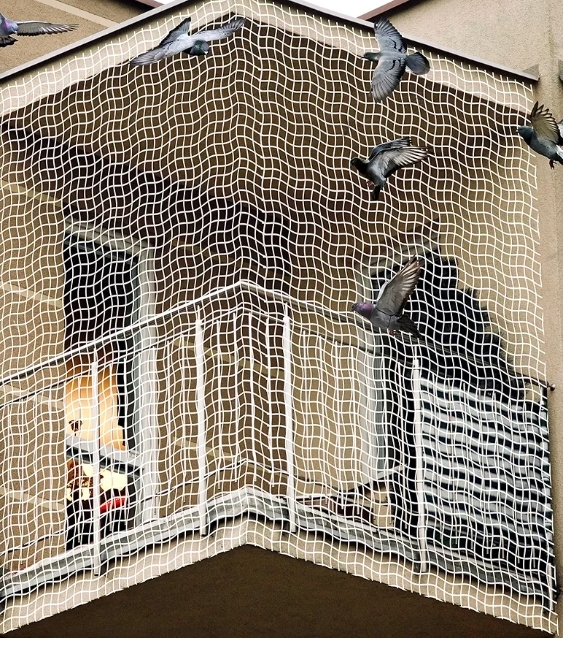
What is Control Pigeon Netting?
Special nets are installed in pigeon-prone areas, which are known as control pigeon netting. These nets serve as a physical obstacle, which does not allow birds to enter certain areas like balconies, rooftops, warehouses, and open buildings. In comparison to the inhumane means of killing, like poisoning or trapping, netting is a harmless technique that does not injure pigeons, it merely drives them out.
The nets are usually constructed using tough materials like polyethylene or nylon that are not sensitive to weather conditions, UV radiation and wear and tear. They are intended to fit into the environment, and usually they are transparent or come in colors that resemble the exterior of that building.
Pigeon Nettings.
Pigeon netting comes in various types which are appropriate in various applications:
Standard Bird Netting: This is the most popular type that is applied to balconies, windows and other small openings. It is light and simple to install and not expensive.
Heavy-Duty Netting: This type is applied in factories, warehouses and other open spaces that have rough environment conditions and is very strong and durable.
Flame-Retardant Netting: It is used in places where fire safety is an issue, e.g. factory and commercial buildings.
Anti-Bird Spikes with Netting Combination: Netting is also used in combination with spikes in certain situations to increase their effectiveness particularly in high pigeon infested areas.
Custom-Fit Netting: It is created to suit the requirements of special architectural buildings in order to be fully covered and to blend with the building.
Installation Process
Installation of pigeon netting should be well-planned and installed to ensure that it is effective and long-lasting. The process of the steps involved is usually the following:
Onsite Visits: Experts inspect the area to identify the existence of pigeons, access points, and building aspects.
Measurement and Design: The netting system to be designed must fit within without gaps, which is achieved by making accurate measurements.
Frame Installation: It involves a structure that is normally made of stainless steel wires or cables that are mounted onto which the net is carried.
Net Repair: The net is attached to the structure using hooks, ties or fasteners.
Inspection and Testing: Strength, stability and completeness of the installation are checked in order to prevent any entrances points.
Installation is also a critical factor because when netting is not installed properly, there is a possibility that it is re-entered by pigeons or it can be damaged over time.
Benefits of Control Pigeon Netting.
There are multiple advantages of pigeon netting, which makes it an ideal solution to bird control:
Humane Solution: It does not harm pigeons but allows them to enter places.
Durability: Nets of good quality can still be used after years with minimum care.
Cost-Effective: Netting is a single investment compared to the repeated cleaning and repairing of the damages by pigeons.
Low Maintenance: When installed, it takes minimal maintenance.
Versatility: Can be used in residential, commercial, and industrial applications.
Aesthetic Appeal: Contemporary netting is intended to be subtle and has no major impact on the appearance of buildings.
Health Protection: Lessens contact with dangerous pathogens related to pigeon droppings.
Challenges and Considerations
In spite of all the benefits, pigeon netting also requires some challenges and considerations:
Initial Cost: Although this is cost effective in the long run, the initial cost of installation can be an issue to certain property owners.
Professional Installation Requirement: It may turn unprofessional when improperly installed and thus the services of a professional are necessary.
Checks on maintenance: Despite being minimal, regular inspections are required to make sure that the net is in good condition.
Environmental Factors: Weather: Weather conditions can be extreme and thus it may influence the quality of the net in case of low quality materials used.
Ethical Issues: This is humane, but care should be taken to make sure that there are no birds trapped inside the time of installation.
Comparison to other Bird Control means.
Controlling the pigeon population can be done by alternative means such as spikes, electric deterrent devices, sound devices or even chemical repellents. But they all are limited:
Bird Spikes: Can work on ledges, but not on big open spaces.
Sound Devices: With time, these tend to be ineffective when pigeons develop resistance to the sound.
Chemical Repellents: Temporary and can be in need of regular reapplication.
By contrast, pigeon netting is one of the most reliable options offering a full coverage and high effectiveness over time.
Uses of Pigeon Netting.
Pigeon netting can be very common in many locations such as:
Residential Buildings: Balconies, windows and terraces.
Industrial Facilities: Warehouses, factories and storage units.
Public Infrastructure: Bridges, railway stations and airports.
Farmland: Preventing damage of crops and storage facilities by birds.
Its versatility allows its use in almost any setting that needs pigeons controlled.
Environmental Impact and Ethical Impact.
Before installation, installers should make sure there are no birds trapped in confined areas and that they do not clear nesting areas indiscriminately. Frequent observation can also secure the system is human and efficient.
Future Projections of Bird Control.
With the ever-rising urbanization, there will be the need to have effective solutions in terms of bird control. Pigeon netting innovations involve use of stronger construction materials, enhanced aesthetic constructions, and connectivity with smart building systems. There is also a growing trend towards the use of environmentally-friendly and recyclable materials, which are in line with the global sustainability objectives.
The pigeon netting is becoming accessible and efficient because of the development of installation methods and alternatives of customization. The more advanced solutions that incorporate netting with other non-invasive deterrents should be expected in future in order to make them more effective.
Conclusion
Control pigeon netting is an extremely efficient, humane and sustainable method of controlling pigeon related issues in urban areas. It stops access to nesting and roosting places, hence solving the problem at the source without causing harm to the birds. It is a perfect solution to residential, commercial and industrial uses due to its durability, versatility, and low maintenance.
Although it is necessary to install it properly and maintain it periodically, the long-term benefits are much higher than the initial investment. With the evergrowing cities, pigeon netting will become an important aspect of ensuring cleanliness, structural integrity, and health. Such humane and effective solutions will help the urban communities to ensure a harmonious coexistence with wildlife and at the same time, maintain the quality of their living environments.
© 2026 Control Pigeon Netting, All Rights Reserved